
By Marius Musa Kargbo
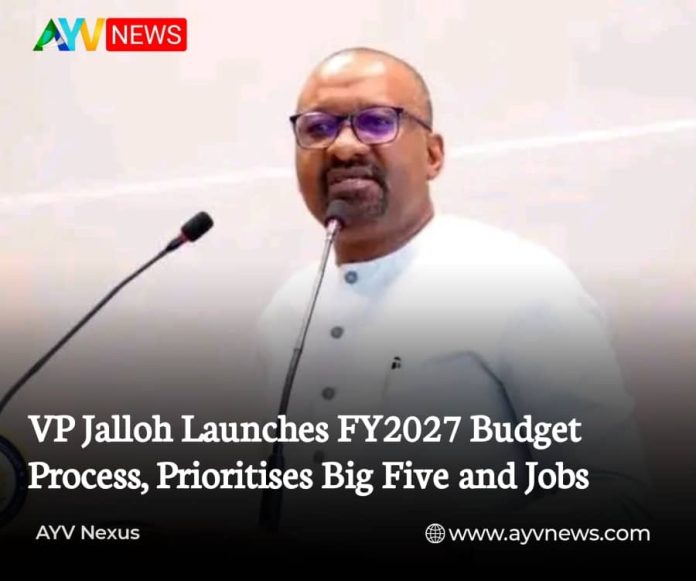
Vice President Dr. Mohamed Juldeh Jalloh has officially launched Sierra Leone’s FY2027 Budget Process, calling for a disciplined, results oriented and investment-focused national budget capable of strengthening economic resilience and creating more opportunities for young people.
The launch took place at the Miatta Conference Centre under the theme, “Building Resilience to Create Jobs.” The theme reflects the Government’s growing emphasis on linking public spending to employment creation, private-sector expansion and improved livelihoods for citizens.
Addressing government officials, development partners and other stakeholders, Vice President Jalloh said the FY2027 Budget must go beyond the allocation of funds. He stressed that it should serve as a practical instrument for delivering the Government’s development priorities, completing strategic investments and producing measurable results across the country.
According to him, the budget process must be guided by fiscal discipline, stronger implementation and a clear understanding of the country’s economic realities. He urged Ministries, Departments and Agencies to ensure that their proposals are realistic, properly prioritised and directly connected to national development objectives.
Big Five Game Changers to Drive Budget Priorities
At the centre of the Vice President’s message was the Government’s Big Five Game Changers: Feed Salone, Human Capital Development, the Youth Employment Scheme, Transforming the Education System, and Technology and Infrastructure.
Dr. Jalloh reaffirmed that these priorities remain central to the Government’s development agenda and must receive the necessary support in the FY2027 Budget.
He said the budget should not only protect ongoing programmes under the Big Five but must also ensure that resources are directed towards initiatives capable of delivering visible improvements in the lives of citizens.
The Feed Salone initiative, for example, is expected to contribute to food security, reduce dependence on imported food and strengthen agricultural production. The Vice President’s emphasis on human capital development and education also reflects the Government’s focus on building a skilled, productive and competitive population.
Technology and infrastructure, meanwhile, remain critical to improving connectivity, supporting businesses, expanding access to services and creating an environment in which private investment can grow.
Dr. Jalloh said the success of these priorities would depend on effective coordination, timely implementation and proper monitoring. He cautioned that government programmes must be assessed not only by the amount of money allocated to them but also by the results they produce.
Youth Employment Remains a Major Government Target
The Vice President placed particular emphasis on the Government’s commitment to creating 500,000 jobs for young people by 2030, with women expected to account for at least 30 percent of the beneficiaries.
He said the target would require a deliberate and coordinated approach involving government, the private sector, development partners and financial institutions.
Dr. Jalloh noted that government alone cannot create all the jobs needed by Sierra Leone’s growing youth population. He therefore called for stronger support to the private sector and increased investment in productive areas, including agriculture, manufacturing, energy, tourism, technology and other emerging industries.
He explained that the FY2027 Budget must help create the conditions for businesses to expand, employ more people and contribute meaningfully to national development.
This, he said, would require policies that encourage investment, improve access to finance, reduce unnecessary barriers to doing business and strengthen the skills of young people entering the labour market.
The Vice President’s remarks come at a time when youth unemployment and underemployment remain major concerns for Sierra Leone. Many young people continue to face difficulties in accessing decent work, business opportunities and the skills required to compete in a changing economy.
The Government’s job-creation target is therefore expected to influence budget decisions across several sectors, particularly those with the potential to generate large-scale employment and support entrepreneurship.
Call for Stronger Private-Sector Participation
Dr. Jalloh stressed that private-sector growth must be treated as a central pillar of the country’s economic strategy.
He said investment in agriculture, manufacturing, energy, tourism and technology could help diversify the economy, increase domestic production and create sustainable employment.
For this to happen, he called for an investment climate that is predictable, transparent and supportive of businesses. He also urged policymakers to ensure that tax measures are evidence-based and designed to support economic activity while improving domestic revenue mobilisation.
The Vice President said Sierra Leone must strike a balance between raising the revenue needed to finance public services and avoiding policies that discourage investment or place excessive pressure on businesses.
He also highlighted the importance of prudent debt management and improved budget credibility. According to him, responsible borrowing and effective use of public resources are essential to protecting the country’s fiscal stability.
Development Partners Recognised for Continued Support
Vice President Jalloh expressed appreciation to Sierra Leone’s development partners for their continued support to the country.
He acknowledged their contributions to development programmes, budget support, infrastructure projects, social-sector interventions, institutional reforms, technical assistance and private-sector development.
Among the partners specifically recognised were the International Monetary Fund, the World Bank, the European Union and the African Development Bank, as well as other bilateral and multilateral institutions.
Dr. Jalloh said these partners had supported Sierra Leone during difficult periods and continued to work with the Government to strengthen institutions, improve the investment climate and expand opportunities for private investment.
He reaffirmed the Government’s commitment to maintaining constructive partnerships with development institutions while ensuring that external support remains aligned with national priorities.
The Vice President’s recognition of development partners also underscored the importance of international cooperation in supporting Sierra Leone’s economic recovery and long-term development ambitions.
Ministries and Agencies Urged to Focus on Results
As the FY2027 budget process begins, Dr Jalloh urged Ministries, Departments and Agencies to take greater responsibility for the outcomes of their programmes.
He said each institution must be able to clearly explain what it intends to deliver, the resources required, the timeline for implementation and the measurable results expected.
This approach, he said, would help improve accountability, reduce waste and ensure that public funds are directed towards programmes with the greatest potential impact.
The Vice President also called for stronger coordination among government institutions to avoid duplication and ensure that national priorities are implemented in a coherent manner.
He emphasised that budget proposals should be based on evidence and national needs rather than institutional demands alone.
Budget Process Expected to Strengthen Fiscal Discipline
The FY2027 Budget Process is expected to provide an opportunity for the Government to review existing programmes, identify areas requiring greater investment and improve the efficiency of public spending.
Dr. Jalloh called for fiscal discipline at every stage of the process, from planning and allocation to implementation and reporting.
He said the Government must ensure that available resources are used carefully, particularly in an environment where public finances remain under pressure and citizens expect improved services.
The Vice President also stressed the need for timely implementation. Delays in executing projects and programmes, he noted, can reduce their impact, increase costs and weaken public confidence.
He urged government institutions to treat the budget as a commitment to the people and to ensure that approved programmes are implemented within the agreed timelines.
“Time Matters, Implementation Matters, Results Matter”
Declaring the FY2027 Budget Process officially launched, Vice President Jalloh said the success of the exercise would ultimately be judged by its impact on citizens.
He emphasised that the budget must support economic resilience, strengthen national development priorities and create opportunities for young people.
His closing message was clear: “Time matters, implementation matters, and results matter.”
The statement captures the central challenge facing the FY2027 Budget Process. Beyond the preparation of documents and approval of allocations, the Government will be expected to demonstrate that public resources are producing tangible improvements in employment, education, agriculture, infrastructure, technology and social development.
With the Big Five Game Changers at the centre of the process, the FY2027 Budget is expected to serve as a key instrument for advancing Sierra Leone’s development agenda and supporting the Government’s ambition to build a more resilient, productive and inclusive economy.

