
By Hawanatu Umu Sineoritta Adams
A newspaper article that sparked a diplomatic disagreement in 2017 has, years later, become the beginning of a remarkable journey of friendship, scholarship and deeper understanding between Sierra Leone and China.
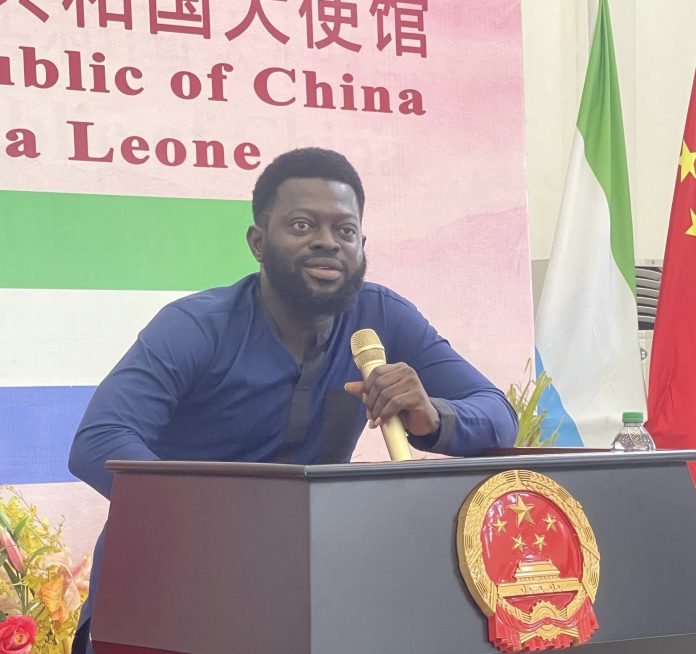
Speaking at the Chinese Embassy Media Open Day in Freetown, journalist and academic Marius Musa Kargbo reflected on his personal experience in China, describing his journey as one that moved him “from questioning to understanding, from distance to friendship, and from journalism to scholarship.”
Kargbo recalled that his China story began in 2017 when he was serving as Executive Editor of the AYV Newspaper and published an article titled “The Chinese Cosmetic Road.”
The article attracted the attention of the Chinese Embassy, with the then Chinese Ambassador to Sierra Leone, His Excellency Wu Peng, expressing dissatisfaction with aspects of the publication.
What followed, Kargbo said, was nearly a month of discussions, explanations and exchanges, including engagement through the then Public Relations wing of Parliament involving Cyril Juxin Smith.
Rather than allowing the disagreement to become confrontational, the parties chose dialogue an approach that eventually opened an unexpected door for the journalist.
Kargbo was invited to lead a Sierra Leonean delegation to the 2017 Youth Festival in Beijing and Xi’an, marking his first visit to China.
«“My experience in China did not begin at an airport. It began in Freetown, Sierra Leone, in 2017 with a pen,” Kargbo told the gathering.
He said the trip fundamentally changed his understanding of China, teaching him that “there is a huge difference between knowing about a country and actually experiencing it.”
Rather than relying solely on headlines and opinions, Kargbo said he deliberately chose to observe, listen, ask questions, interact with people, experience the culture and taste Chinese food.
That experience, he explained, challenged some of his earlier assumptions and exposed him to a more complex picture of China’s development.
According to Kargbo, China’s transformation cannot be reduced to skyscrapers, high-speed trains, technology, roads and bridges.
“China is a story of people, planning, discipline, patience, innovation and long-term vision,” he said.
He identified one of the major lessons from his experience as the understanding that development is a journey, not an event with successive generations building on the achievements of those before them.
His visit to Xi’an and Beijing also gave him an appreciation of how China has combined its ancient civilisation with modern development.
“In Xi’an, I encountered history. In Beijing, I encountered modernity,” he said, arguing that China demonstrated that a nation does not necessarily have to abandon its history in order to build its future.
Kargbo said this experience made him reflect on Africa, which also possesses rich histories, cultures, traditions and human capital.
He challenged Africans to focus on transforming those assets into engines of modern development.
His relationship with China subsequently moved beyond that of a visitor.
Kargbo later studied in China, including at Fujian Normal University, before continuing his academic journey at the University of International Business and Economics in Beijing.
He said becoming a student and researcher in China gave him another perspective, allowing him to experience the country beyond tourism and journalism.
“I was no longer simply a visitor. I became a student, researcher and member of an international academic community,” he said.
Kargbo also highlighted Chinese culture, particularly the emphasis on family, education, respect for elders, hard work, discipline and pride in civilisation.
And, with a touch of humour, he said Chinese cuisine became another important part of his cultural education.
“Chinese cuisine taught me that food can be diplomacy,” he said, noting that sharing meals can create friendships even where language barriers exist.
Ambassador Zhao: ‘Be Witnesses to the Real China’
Kargbo’s personal reflections came against the backdrop of a broader message from Chinese Ambassador to Sierra Leone, His Excellency Zhao Yong, who used the Media Open Day to highlight the growing depth of China-Sierra Leone relations.
Ambassador Zhao said 2026 marks the 55th anniversary of diplomatic relations between China and Sierra Leone, describing the relationship as one built on mutual respect, support and cooperation in areas including politics, trade, health, education and people-to-people exchanges.
He disclosed that bilateral trade reached US$2.3 billion in 2025, representing an increase of almost 30 percent over 2024, while Sierra Leone’s exports to China increased by more than 40 percent. In the first half of 2026, bilateral trade had risen by almost 38 percent, prompting the Ambassador to predict a new record high by the end of the year.
Ambassador Zhao attributed the rapid growth partly to China’s zero-tariff treatment for Sierra Leone and revealed that discussions are ongoing on the export of Sierra Leonean palm oil, coffee and cocoa to China, in addition to fishing products.
He also pointed to a series of activities marking the 55th anniversary, including cultural programmes, SLBC’s Talk to China, the Sierra Leone Association of Journalists’ “China–Sierra Leone Cooperation in My Eyes” short-video competition, and a five-part documentary produced by SLBC, AYV and Star TV.
The Ambassador further described 2026 as the China-Africa Year of People-to-People Exchanges, highlighting measures intended to facilitate travel and exchanges between the two countries.
He said more than 6,000 Sierra Leonean citizens travelled to China in 2025, setting a new record.
For journalists, Ambassador Zhao issued a direct challenge: to go beyond stereotypes and help audiences understand China through firsthand experience.
“Be the witnesses to the real China,” he urged, calling on journalists to document practical China-Sierra Leone cooperation and the everyday human stories connecting the two peoples.»
He also encouraged the media to serve as communicators of friendship while maintaining objective and impartial journalism and remaining vigilant against false information.
From disagreement to friendship
For Kargbo, Ambassador Zhao’s message resonates deeply with his own experience.
He said his journey taught him that countries cannot be fully understood from a distance and that perceptions can sometimes become barriers to genuine understanding.
“Never allow distance to become a substitute for understanding,” he said.»
Kargbo urged Africans to engage China with curiosity, confidence and critical understanding, cautioning against both romanticising and demonising the country.
Instead, he said, Africa should study China’s achievements, identify lessons that can be adapted to African realities and maintain the confidence to engage China on its own terms.
“China’s story is not only a Chinese story,” Kargbo said. “It is a story that Africans can study, question, debate, learn from and engage with on our own terms.”
Looking back at the disagreement that began with his 2017 newspaper article, Kargbo said he now views the episode with gratitude.
What began with a controversial headline eventually led to travel, education, cultural exchange, academic scholarship and lasting friendship.
His final message was simple but powerful:
“My China story began with a disagreement. It continued through dialogue. It developed through travel. It deepened through education. And it matured through friendship.”
For a journalist who once questioned China from a newsroom in Freetown, the journey has become something far more profound a personal case study in how dialogue can turn disagreement into understanding, and how people-to-people exchanges can build bridges between nations.
“Today, I do not claim to know everything about China,” Kargbo said. “But I can confidently say: I understand China far better than I did in 2017.”
谢谢中国! Thank you, China.

