
By Alie Bangura
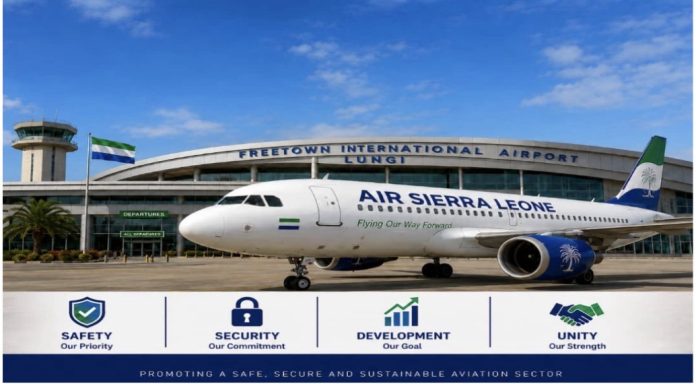
Air Sierra Leone’s emergence into the country’s aviation space was widely received as a symbol of national pride and renewed ambition in restoring direct international connectivity, particularly between Freetown and the United Kingdom. However, beneath the surface of public debate, political interpretation, and social media narratives lies a more complex operational reality that deserves careful examination.
A Full Year of Operations Under Extreme Conditions
Available operational evidence indicates that Air Sierra Leone has already maintained continuous operations for approximately one year. Within that period, particularly during 60 to 80 percent of its operational timeline, the airline operated a 189-seater Boeing 737 aircraft under consistently low passenger demand.
In many instances, flights reportedly carried fewer than 20 to 30 passengers per departure.
From an aviation economics standpoint, such a load factor places any commercial airline under severe financial strain. Fuel costs, maintenance, crew deployment, airport handling charges, and leasing obligations far exceed revenue generated under such conditions. In normal commercial settings, this level of performance would have forced suspension or collapse of operations.
Yet Air Sierra Leone continued flying.
Beyond Profit: A National Development Commitment
The continuation of operations under these conditions reflects a strategic decision that goes beyond commercial logic. Sources within the aviation ecosystem and stakeholder discussions suggest that the airline’s sustained operations were driven by a broader commitment to national development objectives, particularly improving connectivity between Sierra Leone and key international destinations.
This includes addressing a long-standing gap in direct Freetown–United Kingdom air connectivity, which has historically forced passengers to rely on longer, more expensive, and less efficient transit routes through third countries.
In this context, Air Sierra Leone positioned itself not merely as a commercial carrier, but as part of a national infrastructure solution.
Aviation Reality: A Global Industry Under Pressure
It is important to situate Air Sierra Leone’s challenges within the wider global aviation environment.
The airline industry worldwide is currently facing significant operational pressure. Rising fuel costs, fluctuating demand, aircraft leasing expenses, and post-pandemic route restructuring have forced even major global carriers to adjust operations.
Established airlines such as Lufthansa have reduced or restructured routes in response to cost pressures, while budget carriers like Ryanair have also made strategic adjustments in certain markets due to rising operational expenses.
These developments confirm a broader reality: aviation sustainability is increasingly sensitive to global economic shifts, not just local demand.
Air Sierra Leone’s challenges, therefore, cannot be viewed in isolation from this global context.
Regulatory Constraints and UK Connectivity Challenges
A further structural challenge lies in regulatory requirements governing international operations.
To maintain direct UK connectivity, Air Sierra Leone must operate within the framework of Air Operator Certification (AOC) compliance and, in practice, partner with a UK-based AOC holder. This requirement introduces operational dependency, affecting scheduling flexibility, cost structures, and route stability.
These constraints are not unique to Air Sierra Leone but are part of international aviation safety and regulatory frameworks that govern cross-border airline operations.
The Uncomfortable Question: Local Patronage
Perhaps the most critical and sensitive issue emerging from this analysis is the question of passenger behaviorand national patronage.
Even during periods when operations were relatively stable and flights were consistently available, passenger uptake from Sierra Leonean travelers remained low. Many passengers continued to choose alternative routes, often longer and more expensive, instead of supporting the national carrier.
This raises a broader national question that extends beyond aviation:
Is there a trust gap, a perception issue, or a structural mindset challenge when it comes to supporting locally branded national services?
This is not simply a business concern—it is a reflection of national economic behavior, consumer confidence, and collective ownership of national development initiatives.
A National Conversation, Not a Political One
The case of Air Sierra Leone should not be reduced to political interpretation or short-term criticism. Instead, it should be examined as part of a broader national development strategy involving infrastructure, aviation policy, citizen engagement, and economic sustainability.
The airline’s year-long operation under heavy financial pressure, global industry turbulence, regulatory complexity, and weak passenger support presents a reality that requires reflection rather than reaction.
Conclusion:
A Test of National Economic Maturity
Air Sierra Leone’s journey reflects more than an airline struggling or succeeding. It reflects a national test—of whether Sierra Leone can collectively support, sustain, and build institutions that represent its own identity in global systems.
The challenge now is not only operational sustainability, but national participation.
Because in aviation, as in national development, no airline can succeed in isolation from the people it serves.

