
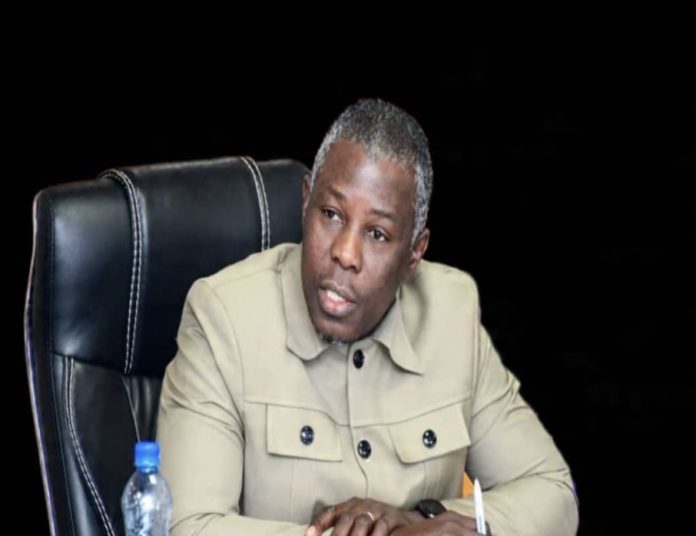
Aruna Turay, AYV News, January 28, 2026
The National Chairman and Leader of the National Grand Coalition (NGC), Mohamed Koroma, has accused Sierra Leone’s two dominant political parties – the ruling Sierra Leone People’s Party (SLPP) and the main opposition All People’s Congress (APC) Party of greed and political intolerance, arguing that they behave as though they own the country.
Speaking on AYV Television’s Wake Up Sierra Leoneprogramme, Koroma condemned proposals suggesting that political parties which fail to win parliamentary seats in two consecutive elections should be deregistered. He described such moves as an attempt to stifle democracy.
“If you say a political party that does not win a seat in parliament in two elections should be deregistered, then you are stifling democracy,” Koroma said. “This shows the greediness between the APC and the SLPP. They are behaving as if they own Sierra Leone, yet statistics show that over 35 percent of Sierra Leoneans are not affiliated with either of these two parties. So how can they claim ownership of the country?”
Koroma noted that while the adoption of a Proportional Representation (PR) system is not a major concern for the NGC and other smaller parties, the threshold requirementremains problematic. He argued that the proposed national threshold – reportedly above 11 percent – is excessively high and lacks clarity in its calculation.
“An over 11 percent threshold nationwide is bad, and we may not even understand how such a percentage will be calculated,” he said. Koroma disclosed that the NGC, alongside fifteen other smaller political parties, has submitted a position paper calling for a reduction in the threshold to ensure broader political participation.
Addressing claims that the NGC has been inactive since the elections, Koroma dismissed such assertions, stating that the party is commencing its lower-level internal elections. According to him, the process will see the election of more than 8,000 executive members at the ward level nationwide.
He further called for political maturity after elections, urging parties that win to focus on governance while those that lose should reorganise and rebuild, rather than engaging in activities that heighten political tension and undermine national stability.
Meanwhile, Olushogo Davies, Executive Secretary of the Political Parties Regulation Commission (PPRC), clarified that Recommendation 70 of the Tripartite Committee addresses the possible deregistration of political parties that fail to secure parliamentary seats in two consecutive elections. However, he stressed that the Commission does not support narrowing the political space.
Davies explained that under Section 12(2) of the Political Parties Act, the PPRC is mandated to promote political pluralism. “We would not want a situation where the political space is shrunk,” he said.
He added that in many advanced democracies, some political parties are not primarily focused on winning elections but on advancing specific developmental and policy issues such as environmental protection, climate change, mining, education, and health.
“As a Commission, we cannot authoritatively say this is the way to go, but we remain conscious of our mandate under Section 12(2) of the Political Parties Act, particularly our responsibility to ensure political pluralism,” Davies noted.
He concluded by emphasising the independence of the PPRC, stating that no political party is above the law and that the Commission operates independently, without coercion, compromise, or influence from any institution or group.

