
AYV News, October 28, 2026
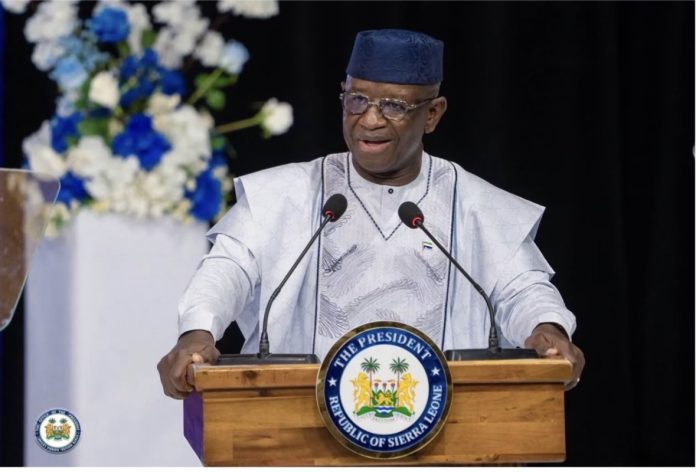
President Dr Julius Maada Bio has called on Sierra Leoneans to move beyond simply preserving peace to making it deliver a better life for every citizen, declaring that national unity must be built on justice, inclusion, accountability and tangible improvements in people’s daily lives.
Opening the National Unity and Social Cohesion Conference 2026, the President apologised to victims and survivors of the civil war on behalf of the State, announced measures to strengthen reparations and reconciliation, and reaffirmed his commitment to a peaceful transfer of power in 2028, declaring unequivocally that he would not be a candidate in the next presidential election.
Speaking on the theme “From Agreement to Action: Strengthening Unity, Advancing Social Cohesion, and Building a More Peaceful Sierra Leone through Conflict Prevention,” the President said that while his generation’s responsibility was to end the civil war, the task before the country today was to make peace meaningful in the daily lives of its people.
“For as long as I remain in office, I will work for a Sierra Leone where families can put food on the table, children can learn, clinics can care for the sick, and young people can find meaningful work,” President Bio assured the nation.
Addressing the topic “Sierra Leone’s Next Chapter of Peace and National Unity,” the President recalled the declaration marking the end of the civil war in January 2002, noting that while the declaration could not restore lives lost or rebuild destroyed homes, it began the more difficult work of rebuilding trust and learning to live together again.
He welcomed former President Ernest Bai Koroma, international guests and the international moral guarantors of the Agreement for National Unity. He also thanked the ICPNC for convening the conference, describing it as an opportunity to reflect on the country’s peacebuilding journey and determine the way forward.
President Bio acknowledged the contributions of successive governments, women’s organisations, the Inter-Religious Council, civil society, the media and local communities in safeguarding peace. He noted that Sierra Leone had held elections and experienced two peaceful transfers of power, but cautioned that sustaining peace required more than political milestones.
“Peace must become part of our national culture. It must be visible in the laws we uphold, the institutions people trust, and how we treat one another,” he said.
Reflecting on the causes of the civil war, President Bio identified long-standing grievances, exclusion, injustice, abuse of authority and the denial of a fair share in the country’s opportunities as issues that contributed to the conflict. He acknowledged the State’s failure to protect citizens from the suffering that followed and recalled former President Koroma’s 2010 apology to women who suffered during the war.
President Bio then offered a direct apology to survivors, bereaved families, children whose childhoods were disrupted and all Sierra Leoneans who endured the conflict.
“On behalf of the State of Sierra Leone, I apologise for the suffering you endured and for the protection you did not receive. I am SORRY,” he declared.
To give practical effect to reconciliation, the President directed the National Commission for Social Action and other relevant institutions to review and strengthen the reparations programme recommended by the Truth and Reconciliation Commission (TRC). He also directed that a public report on the implementation of the TRC recommendations be presented to the nation by 18 January 2027.
Additionally, he called on the Ministry of Health to work with the Peace Commission and faith communities to expand mental-health and psychosocial support for people still affected by the trauma of the war.
On democratic continuity and the peaceful transfer of power, President Bio reaffirmed his commitment to constitutional governance, stating that he would complete his mandate in 2028 and hand over the Presidency to the candidate chosen by Sierra Leoneans.
“In 2028, I will complete my constitutional mandate and hand over the Presidency peacefully to whomever Sierra Leoneans choose. Let me state this without qualification; I will not be a candidate in the 2028 Presidential Election,” he stated.
The President also proposed a National Peace and Cohesion Action Framework; a Peace Basket Fund to support community peacebuilding and remembrance; a strengthened Inter-Party Dialogue Committee; and a Code of Conduct for Peaceful Elections, which all registered political parties would be encouraged to sign before the 2028 elections.
His proposals further included peace and civic education in schools, a National Peace Week culminating on 18 January 2027 to mark 25 years of peace, and the commencement of work on a National Peace Memorial.
Former President Ernest Bai Koroma described the conference as a serious national moment requiring the commitment of every citizen to examine the state of peace and national cohesion. He thanked President Bio for facilitating his return to Sierra Leone and acknowledged his contribution to the country’s peacebuilding process, including the establishment of the Peace Commission.
The Former President reaffirmed his willingness to support President Bio’s efforts by drawing on his experience to help advance national peace and cohesion. He called for greater national ownership of the peacebuilding agenda and urged Sierra Leoneans to confront outstanding challenges through open and honest dialogue.
Representatives of the United Nations, ECOWAS, the diplomatic community and other stakeholders also contributed to discussions on strengthening peace, political dialogue, national unity and social cohesion.
The conference provides a platform for national leaders and stakeholders to assess Sierra Leone’s peacebuilding progress and identify practical measures to address unresolved grievances, strengthen public trust and ensure that peace translates into tangible improvements in citizens’ lives.

