
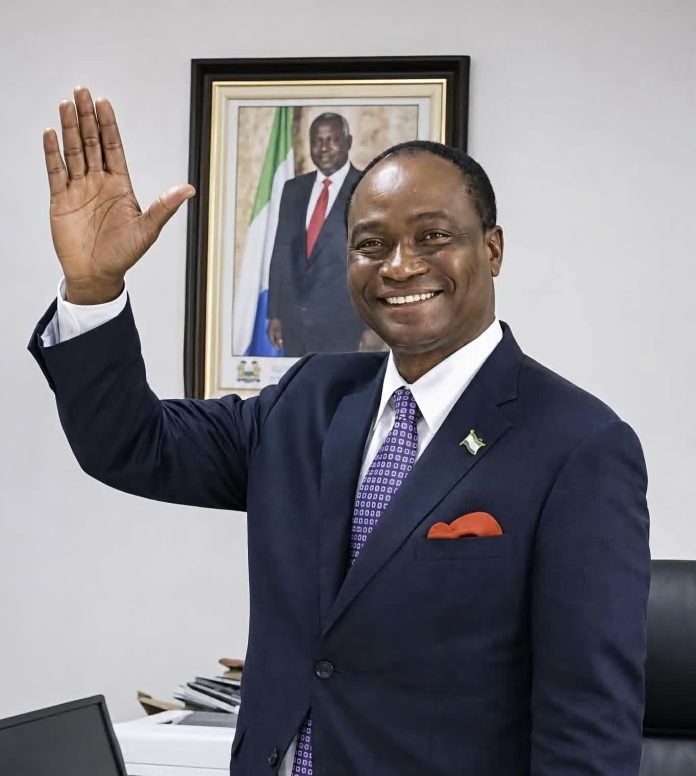
By Marius Musa Kargbo
As Sierra Leone’s main opposition All People’s Congress (APC) prepares for the 2028 presidential election, one question continues to attract attention: What role should Dr. Samura Mathew Wilson Kamara play in the party’s next political chapter?
At 75, with more than four decades of experience in public administration, economic management and international diplomacy, Kamara remains one of the country’s most experienced political figures. Yet his two unsuccessful presidential bids in 2018 and 2023 have intensified the debate over political continuity, generational transition and leadership renewal within the APC.
His latest appearance on AYV’s State of the Nation has brought those questions back into focus.
A Politician Who Says the Decision Belongs to the Party
During the interview, Kamara maintained that the selection of the APC’s 2028 presidential candidate rests with the party and its members, not with him.
“Let them campaign now. They did the same in 2018 and 2023. I am waiting for the party and its people to decide their choice for 2028,” he declared.
His remarks suggest that he is leaving the question of his political future to the party’s internal processes rather than publicly announcing a third presidential bid.
However, they also leave open an important question: Is Kamara preparing for another contest, or is he positioning himself to influence the party’s future leadership?
A Career Spanning Different Governments
Few contemporary Sierra Leonean politicians can point to a public service career as extensive as Kamara’s.
An economist by training, he obtained his first degree from Fourah Bay College before pursuing postgraduate studies in the United Kingdom, where he earned a doctorate in development economics.
His professional career included service in the Ministry of Finance, the Commonwealth Secretariat and international financial institutions.
He held senior economic management responsibilities under different administrations, including that of former President Ahmad Tejan Kabbah.
Following Ernest Bai Koroma’s election in 2007, Kamara became Governor of the Bank of Sierra Leone, serving until 2009. He subsequently became Minister of Finance and Economic Development before moving to the Ministry of Foreign Affairs and International Cooperation, where he served until 2017.
These appointments exposed him to national budgeting, monetary policy, development financing, economic diplomacy and international relations.
His experience provides a substantial basis for assessing his leadership credentials. However, holding senior public office does not, by itself, establish how effectively an individual would perform as president. That assessment also requires scrutiny of policy outcomes, administrative decisions and accountability.
Two Elections, Two Different Political Battles
Kamara’s transition from technocrat to presidential candidate came in October 2017, when former President Koroma selected him as the APC’s flagbearer for the 2018 election.
He subsequently faced Julius Maada Bio of the Sierra Leone People’s Party (SLPP) in a closely contested presidential runoff.
According to the official results, Bio won with 51.81% of the votes, while Kamara secured 48.19%.
Reflecting on that election during his AYV interview, Kamara maintained that the crowds attending his political rallies reinforced his personal belief that he had won.
“My perception of the crowd that turned out, coupled with my belief, convinces me that I won the 2018 elections,” he stated.
His personal conviction, however, differs from the officially declared election outcome. Campaign attendance alone cannot establish electoral victory.
Kamara returned as the APC presidential candidate in 2023, again facing Bio. The Electoral Commission for Sierra Leone declared Bio the winner with 56.17% of valid votes, against Kamara’s 41.16%.
The 2023 election was accompanied by disputes over electoral transparency, with international observers and diplomatic partners raising concerns about aspects of the results tabulation process.
For the APC, both elections remain important reference points in evaluating its political strategy and future leadership.
The Question of Party Support
Another significant revelation from Kamara’s interview concerned his relationship with the APC leadership during the 2018 campaign.
“While I was campaigning for the presidency in 2018, I never saw any party leadership support. I was left alone, but I did not complain to anyone,” he alleged.
The statement raises questions about internal party coordination, campaign organisation and the relationship between a presidential candidate and the wider political establishment.
Kamara’s account represents his personal experience. A fuller assessment would require responses from those who held leadership responsibilities during the campaign.
Nevertheless, his remarks highlight the importance of party unity and organisational support in any presidential contest.
Continuity in Governance: Kamara’s Central Concern
Beyond his political ambitions, Kamara used the interview to emphasise the importance of continuity in national development.
“If a country wants to succeed, there has to be continuity in government, and it is that lack of continuity that worries me. When you continue to live in denial and focus on criticism, you lose sight of what truly matters,” he said.
His argument touches on a longstanding governance challenge: how successive administrations can preserve effective national programmes while introducing necessary reforms.
Continuity can protect long-term investments in infrastructure, education, healthcare and economic development. Equally, democratic transitions must allow governments to review unsuccessful policies and respond to changing public priorities.
The challenge is therefore not simply whether programmes should continue, but which programmes deserve continuity and how their results should be measured.
The Bio Meeting and Political Relationships
Kamara also disclosed that a meeting with President Bio had been arranged through an intermediary who described the invitation as a personal engagement between longtime friends.
According to Kamara, he attended alone because he understood that the president wanted to meet him personally rather than engage the APC as an institution.
The disclosure provides insight into the personal relationships that can exist between political opponents despite their public disagreements.
It also raises broader questions about the role of informal dialogue in promoting political stability, particularly in a country where relations between the government and opposition have periodically been strained.
Experience Versus Political Renewal
As the APC approaches 2028, Kamara’s record presents several considerations for party members.
His supporters may point to his knowledge of public finance, international diplomacy, institutional management and decades of government service. His experience across different administrations also provides a perspective on the evolution of Sierra Leone’s governance institutions.
Others may question whether the party should nominate a candidate who has already contested two presidential elections without securing victory.
Age is another factor in the public discussion. Born on April 30, 1951, Kamara will be 77 by the time of the 2028 presidential election.
Age alone cannot determine a politician’s competence or suitability for office. More relevant considerations include the candidate’s proposed policies, leadership approach, ability to build an effective team, commitment to accountability and capacity to respond to contemporary national challenges.
For a country confronting youth unemployment, economic pressures, infrastructure needs and demands for stronger public institutions, the substance of a presidential candidate’s programme deserves particular attention.
Retirement, Another Presidential Bid or a Different Role?
Kamara’s experience raises a broader question about the place of veteran political figures in democratic leadership transitions.
Should a politician with decades of public service continue seeking the highest office, or could that experience be equally valuable in mentoring younger leaders, advising on policy and strengthening party institutions?
Neither path automatically guarantees better outcomes.
A further presidential bid would invite renewed scrutiny of Kamara’s policy record, electoral strategy and plans for the country’s future. A decision to support another candidate could open a different chapter in his political career while preserving his contribution to public affairs.
Ultimately, the choice of the APC’s next presidential candidate belongs to its members under the party’s established procedures.
For Sierra Leoneans, the larger question extends beyond one politician’s ambitions. It concerns the leadership qualities, practical policies and standards of accountability needed to address the country’s challenges.
As 2028 approaches, Samura Kamara’s long record of service will remain part of the national political conversation. Whether that record leads to another presidential campaign, a supporting role or retirement is a decision still to be made.

