

Samuel Ibrahim Koroma, AYV News, October 15, 2025
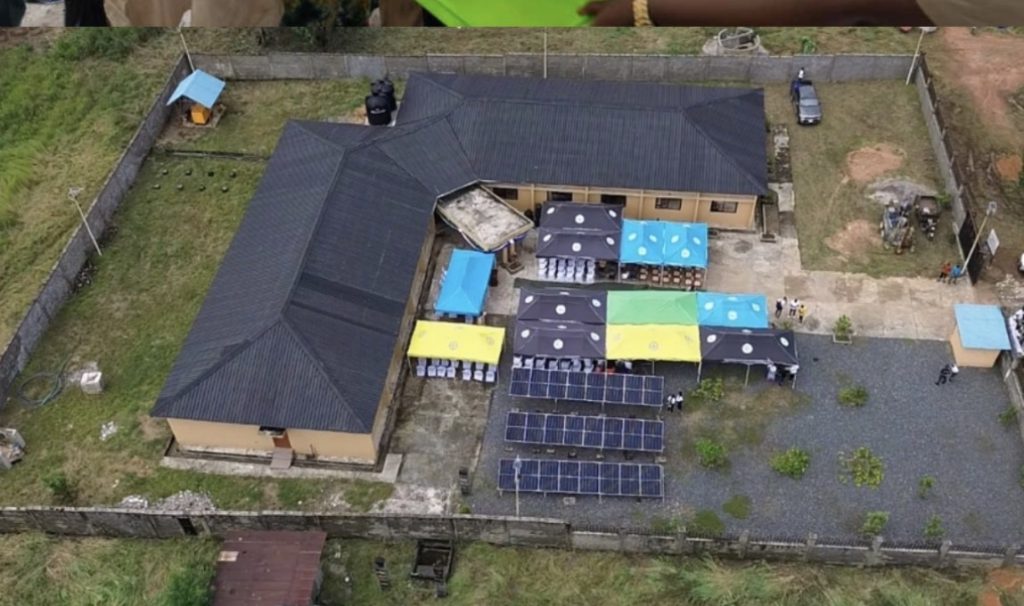
President Julius Maada Bio has officially unveiled and handed over the National Seed Testing Laboratory, a modernised seed testing facility constructed by the Sierra Leone Agribusiness and Rice Value Chain Support Project (SLARiS), with funds from the African Development Bank at Mile 91 in Tonkolili district, Northern region of Sierra Leone.

This agenda is well-seated in the government’s agricultural transformation as espoused in its ‘Feed Salone’ initiative.
The Seed Testing Laboratory is a novel facility in Sierra Leone, equipped with modernised technologies capable of providing quality assurance for end-users of a variety of crop seeds (cuttings and vines), including those from within and outside Sierra Leone, in addition to its capabilities in seed Testing, Purity, viability, quality, and health.
In his keynote speech, President Bio said, “viable seeds are the greatest asset farmers could be proud of”, stressing their importance in transformative agriculture. The laboratory, Bio said, is a critical national asset that must be protected at all cost by residents of Yoni Chiefdom, Mile 91 in Tonkolili district. The laboratory he added is a product of the many travels he had embarked on.
The President concluded by commending the collaborative work of teams from the supervising Ministry of Agriculture and Food Security, Sierra Leone Seed Certification Agency (SLeSCA), Sierra Leone Agribusiness and & Rice Value Chain Support Project (SLARiS) as the implementing project with support from the African Development Bank (AfDB) for executing what seems a life saver for agricultural growth in Sierra Leone.
Executive Director at the Sierra Leone Seed Certification Agency (SLeSCA), Dr. Robert Chakanda reveals they are entrusted with the mandates to regulate, certify and promote the production and use of high-quality seeds; a vision which under the provident leadership of President Bio and with strategic guidance by the Ministry of Agriculture and Food Security same has been transformed into ‘a measurable progress’.
The project, he furthered, has been a cornerstone in transforming Sierra Leone’s seed production. The Agency, he added, has released several improved seed varieties in recent years and is fully staffed with trained personnel, including farmers, to manage the laboratory’s operations.
He also announced a strategic Memorandum of Understanding (MOU) with Njala University to bolster the production of home-grown seeds, ensuring sustainability and local expertise.
Minister of Agriculture and Food Security, Dr. Henry Musa Kpaka, thanked President Bio for his leadership and dedication to rebuilding the country’s agricultural research infrastructure, which suffered severe damage during the war. He described the enactment of the SLARI Act in 2023 as a turning point that revitalised the institution and boosted the morale of agricultural scientists nationwide.
“SLARI remains pivotal to the government’s Feed Salone flagship programme,” Dr Kpaka said. “Thanks to the President’s support, 12 SLARI researchers are currently pursuing PhD programmes, and for the past two years, Sierra Leone has not imported any seeds, a testament to SLARI and SLeSCA’s effectiveness.”
He considered the day a science day for the feed Salone agenda, with SLARi and SLESCA both showcasing what they are capable of doing. The National Seed Testing Laboratoryhe said is a nerve centre for transforming the nation’s seed sector.
“This facility, he reechoed, is first of its kind in Sierra Leone, equipped with everything needed for accurate, internationally-oriented results. It stands as a pillar of Sierra Leone’s seed systems,” Dr. Kpaka said.
He thanked the SLARiS project lead, Tamba Jumu, for delivering such a mind-blowing impact in the agricultural transformation drive of the country, adding that the project truly resonates with the broader national objective of the President’s Feed Salone agenda. He further thanked President Bio for his leadership on the initiative and advocated for further skills training for technicians to maximise the lab’s potential.
Seeds are fundamental to agricultural transformation, serving as the genetic basis for crop productivity, resilience, and foodsecurity. Improved, high-quality seeds are critical for increasing crop yields, enhancing resistance to pests and drought, and providing better nutrition, making them a central element in transforming agriculture into a more productive and sustainable system.

