
AYV News, January 22, 2026
In a judgment that has sent shockwaves through Sierra Leone’s banking and corporate sectors, the Anti-Corruption Division of the High Court in Freetown has sentenced a senior official of the United Bank of Africa (UBA) to a cumulative forty (40) years’ imprisonment for corruption-related offences involving the misappropriation of public funds.
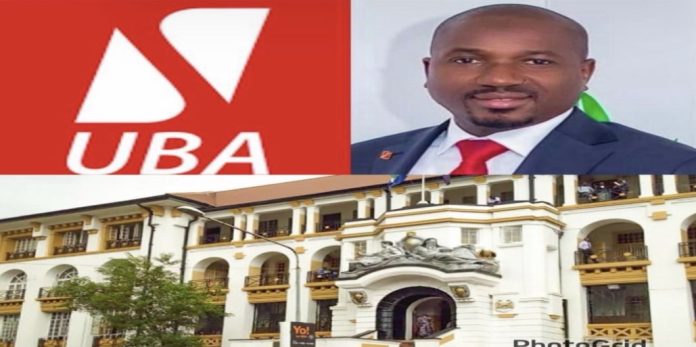
The ruling was delivered on Monday, 19 January 2026, by Honourable Justice Aiah Simeon Allieu, a Justice of the Court of Appeal, sitting at the Main Law Courts Building. The convict, Fredrick Caulker, until his arrest served as Head of Operations at UBA—one of the country’s leading commercial banks—raising serious questions about internal controls, ethical standards, and compliance systems within the institution.
Caulker was arraigned on a five-count indictment under the Anti-Corruption Act No. 12 of 2008, as amended by the Anti-Corruption (Amendment) Act No. 9 of 2019. The charges included conspiracy and multiple counts of misappropriation of public funds, all linked to tax payments made by the Small Holder Commercialization Agri-Business Development Project (SCADeP) to the National Revenue Authority (NRA).
According to evidence led in court, the funds in question were PAYE and withholding taxes—public monies meant to support national development—that were diverted through irregular banking transactions while Caulker was in a position of trust at UBA. The court heard that instead of ensuring the funds were credited into the NRA’s designated accounts, the convict authorized and directed transfers into alternative accounts, contrary to standard banking practice and public finance regulations.
The prosecution called eight witnesses, including banking professionals who worked directly under Caulker. One key witness, a former subordinate at UBA, testified that he processed several large inflows on Caulker’s instructions, despite knowing that the funds were originally intended for the NRA. He told the court that some of the transfers were redirected following verbal instructions from Caulker, often justified by claims of “mistaken transfers” or alleged calls from other bank officials.
These transactions, amounting to nearly two million leones, formed the backbone of the prosecution’s case and exposed what the court described as a deliberate abuse of office. The testimony painted a troubling picture of how weak oversight and unquestioned authority within a major financial institution could be exploited to siphon public funds.
In his ruling, Justice Allieu acquitted Caulker on the conspiracy charge, holding that the prosecution failed to prove the essential elements of conspiracy beyond reasonable doubt. However, the court had no such difficulty on the substantive counts. On counts one to four—each relating to misappropriation of public funds—the court found Caulker guilty and imposed ten (10) years’ imprisonment on each count, to run consecutively.
“The gravity of these offences cannot be overstated,” the court noted, emphasizing that the crimes involved public revenue entrusted to the banking system for safekeeping and proper transfer.
In addition to the custodial sentence, the court ordered Caulker to repay Le1,980,233.40 into the Consolidated Revenue Fund within ninety (90) days, reinforcing the principle that crime must not pay—especially when public resources are involved.
Beyond the individual conviction, the case has cast a harsh spotlight on UBA’s internal governance. Observers argue that such large-scale misappropriation could not have occurred without systemic lapses in compliance, monitoring, and accountability. While the bank itself was not on trial, the proceedings have intensified public scrutiny of how financial institutions handle government-related transactions and safeguard public funds.
The judgment is widely seen as a strong signal from the judiciary that corruption within powerful corporate and financial institutions will attract severe punishment. For citizens, it serves as both a warning and a reassurance: a warning about the risks of unchecked corporate power, and a reassurance that the courts remain a critical line of defence in protecting public resources.
As Sierra Leone continues its fight against corruption, the UBA case stands as a damning reminder that no title, institution, or boardroom is above the law.

