
By Marius Musa Kargbo
The robotics of the future are no longer a far-off dream; they are now reality, changing everything we know about our daily lives, thanks to the power of the robotics of renaissance! Just a few weeks ago I visited Aborseek, a leading Beijing robotics company on a mission to deploy some of the most innovative uses of AI and robotic automation I’ve seen in action, while I was on a training programme sponsored by China’s Centre for International Knowledge on Development under China’s Ministry of Commerce and the Research and Training Institute of the NRTA.

I walked through their door and it was like I walked 100 years into the future. Robots were performing not just highly technical tasks, but also activities that had long seemed to be the preserve of humans. I sat there in admiration watching them twist and turn, spring harmonious tunes from their lips, and glide gracefully across the room. Besides providing entertainment, Aborseek showed how robots are being used in agriculture, manufacturing, logistics and other critical fields, proving themselves indispensible partners in the modern world.
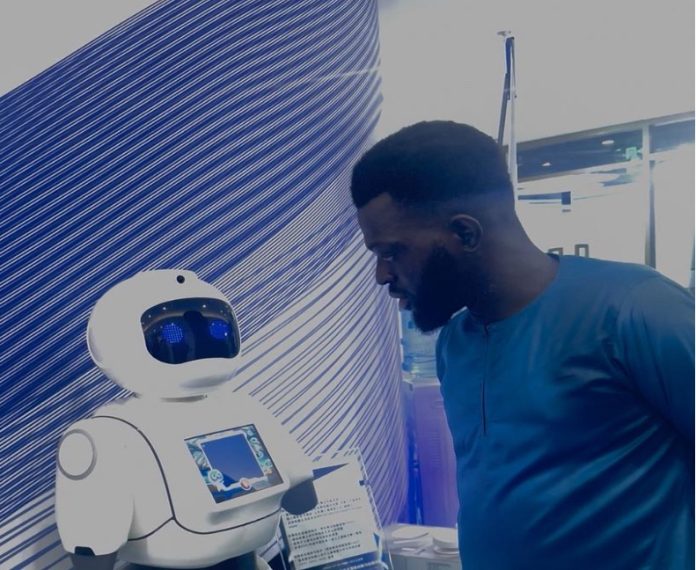
The highlight of my visit, however, was seeing Bingo, one of Abroseek’s most advanced humanoids. Bingo is based on state-of-the-art Natural Language Processing (NLP) which enables it to communicate fluently in both languages! To experiment with this, I once had a conversation with the robot in the two languages. The accuracy and quickness of Bingo’s replies made me stunned it was as if speaking to a human assistant.
But Bingo’s genius extends well beyond talking. It has a heuristic search engine and can solve a wide range of math problems. Just for fun, I had Bingo do a set of hard math problems. It thoroughly taught the solution to the problems at a depth that can be hard to understand without it explicitly showing how it arrived at the answer.” The questions were to help kids get an idea on where they stand in their math. Pact …. It was stunning how quickly, clearly and correctly it was responding, resulting in a stark demonstration of the potential of AI to transform not just education but professional problem-solving as well.
Aborseek also demonstrated their advanced technology in agricultural robot. Today, with robots that can plant seeds, water crops, test soil and more, farmers have to do much, much less. Such technologies serve to lessen reliance on manual labor and can enhance the speed and consistency of food production. For nations such as Sierra Leone, where the economy depends heavily on agriculture, such a technology could be transformational.
Just as important were the lessons about the tension between human creativity and machine efficiency. Robots like Bingo can perform boring, labor-intensive jobs that work tireless without complaint. But there is no AI substitute for the depth of human imagination, empathy and vision. The future is not about replacing humans, but empowering them to do what they do best: solving problems, driving innovation and building better societies, by eliminating grunt work. I saw this happen in Taiyuan, Shanxi Province, even where a robot brought my medicine up to the eleventh floor of my apartment a small act that saved time and energy, but also showed the potential for time and convenience that robotics can bring.
For Sierra Leone, the question is not whether robotics will influence our future it will. The issue is how we prepare strategically to take advantage of it. This includes investments in knowledge sharing, creating partnerships with companies such as Aborseek, and developing policies that drive technological adoption.
I continue to sincerely thank the China Ministry of Commerce and the NRTA Research and Training Institute for providing me with this invaluable experience. For me it was more than showing a piece of technology, it was an insight into the future, a reminder of how far robotics can revolutionize the way we live, learn and work.

