
AYV News, September 10, 2026
The Government of Sierra Leone is advancing comprehensive reforms in the country’s land sector, with emphasis on proper physical planning, development control, decentralisation, digital transformation and the introduction of a more secure land-title registration system.
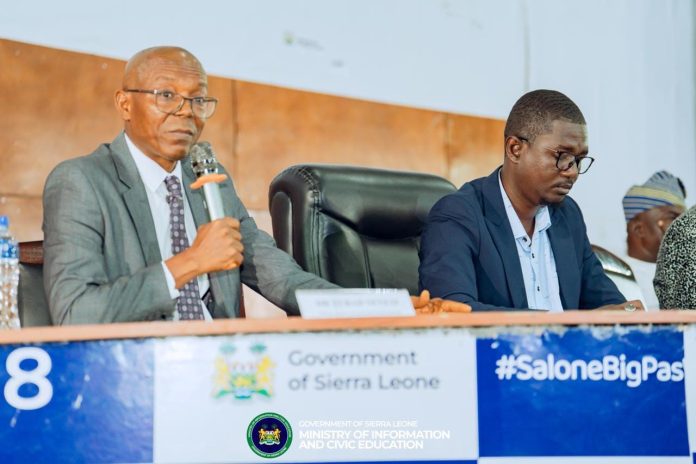
Speaking on the topic “Land Reform – Where Are We?”, Dr. Turad Senesi said the land sector had historically been dominated by discussions around land allocation, while other critical responsibilities, particularly housing and country planning, had not received adequate attention.
He explained that the longstanding concentration on land allocation had contributed to land disputes, conflicts, unplanned settlements and poorly coordinated physical development in communities across Sierra Leone. Dr. Senesi stressed that the Government’s reform agenda is therefore seeking to change the narrative by moving beyond the simple allocation of land towards ensuring that communities are properly planned and developed.
According to him, one of the key areas of the reform is development control, which is intended to ensure that construction and physical development conform to established planning standards. He observed that in many communities, buildings have been constructed without adequate consideration for access roads, sanitation, drainage, water supply, electricity and other essential amenities. Such conditions, he noted, can create serious risks, particularly during emergencies when fire and other emergency services may be unable to access densely built communities because of inadequate or blocked roads.
Dr. Senesi further highlighted the significance of the National Country Planning Act, which he described as an important step towards addressing the country’s longstanding planning challenges. He noted that the previous planning legislation had become outdated and was no longer adequate to respond to Sierra Leone’s current development needs. The new framework, he explained, provides a more modern basis for planning communities, towns, cities and villages while strengthening development control and promoting orderly development.
He emphasised that the new planning approach also places responsibilities on property owners and developers. According to Dr. Senesi, individuals cannot simply acquire land and construct structures without following the appropriate procedures. Developers are expected to engage qualified professionals, undertake the necessary assessments, obtain relevant approvals and ensure that their developments do not negatively affect neighbouring properties or the wider community. He stressed that development control is essential to ensuring that individual property rights are exercised responsibly.
Another major component of the reform is the decentralisation of country planning functions. Dr. Senesi explained that although the Ministry of Lands, Housing and Country Planning will continue to provide policy direction, legislation, regulations, monitoring and evaluation, local councils will increasingly take responsibility for implementation at the community level. He said this approach is important because local councils are closer to the people and understand the realities and development needs of their respective communities.
He disclosed that capacity-building programmes are being undertaken to equip local councils with the knowledge and skills required to implement the new planning framework effectively. Mayors, chairpersons, Chief Administrators, development planning officers, finance officers and other relevant personnel are expected to benefit from the training, given their frontline responsibilities in implementing country planning policies and regulations.
Dr. Senesi also highlighted the role of technology in transforming land administration, particularly in addressing land disputes and improving transparency. He explained that digital systems can help identify land ownership, track transactions and enable prospective buyers to verify information before purchasing property. Such systems, he said, could help reduce instances where the same piece of land is sold to multiple individuals and provide citizens with greater confidence when engaging in land transactions.
A further area of reform is the move towards title registration, which Dr. Senesi identified as an important mechanism for strengthening certainty around land ownership. He explained that while a conveyance can serve as evidence of a land transaction, a properly registered title provides a stronger and more systematic record of ownership and land rights. The reform, he said, is expected to establish a more reliable system through which land can be registered and title certificates issued to legitimate owners.
According to Dr. Senesi, title registration will have wider economic benefits beyond resolving ownership disputes. Secure land titles could improve citizens’ ability to access financing from financial institutions, particularly for large-scale agriculture and other investments where proof of ownership is required. He maintained that a systematic registration process would also help reduce conflicts by creating clear and verifiable records of land ownership across the country.
The reforms are also contributing to improved revenue generation within the land sector. Dr. Senesi noted that the ministry’s revenue performance has increased considerably compared to previous years, attributing the improvement partly to strengthened systems and the provision of land related services. He explained that a more efficient land sector can become an important contributor to national development by generating revenue that can support broader government priorities and social services.
In his concluding remarks, Dr. Turad Senesi stressed that land reform is a long term national undertaking that requires collective responsibility from government institutions, local councils, property owners, developers and communities. He called for greater public understanding of the importance of proper planning, responsible land ownership and compliance with development regulations, noting that the success of the reform will ultimately depend not only on government action but also on the willingness of citizens to participate in and respect the new system. He emphasised that Sierra Leone must move towards a modern, transparent and technology-driven land administration system capable of reducing conflicts, supporting investment and creating properly planned communities for present and future generations.
The engagement was hosted by Mohamed Jaward Nyallay, Strategic Communication Officer at the Ministry of Information and Civic Education, and organised by the Government of Sierra Leone through the Ministry of Information and Civic Education. The discussion formed part of ongoing public engagements aimed at informing citizens about key government reforms and strengthening public understanding of national development initiatives.

