
By Marius Musa Kargbo
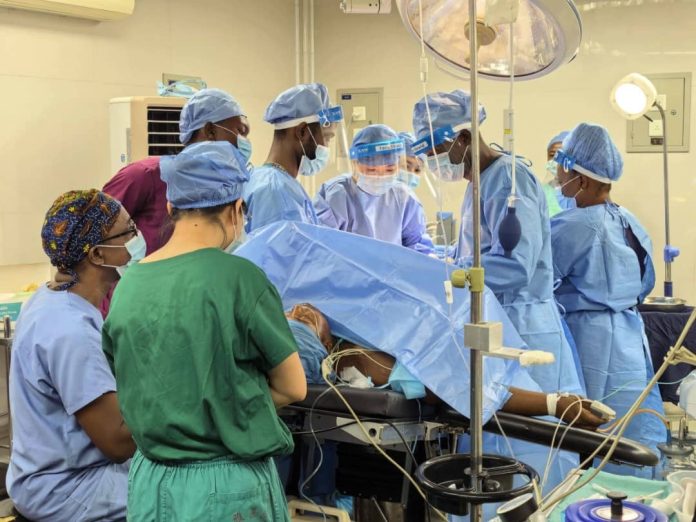
At the operating theatre of the China-Sierra Leone Friendship Hospital, a team of Chinese and Sierra Leonean medical professionals stood over one of the most challenging gynecological cases they had encountered in recent months. Before them was a 43-year-old woman whose life for the past decade had been overshadowed by persistent abdominal swelling, discomfort, and uncertainty.
What appeared at first to be a difficult case soon revealed itself to be far more complex. Medical imaging confirmed that the patient was suffering from multiple massive uterine fibroids. Her uterus had expanded to the size of a seven-month pregnancy, occupying nearly the entire pelvic cavity and compressing surrounding organs. The scale of the condition posed not only severe health risks but also extraordinary surgical challenges.
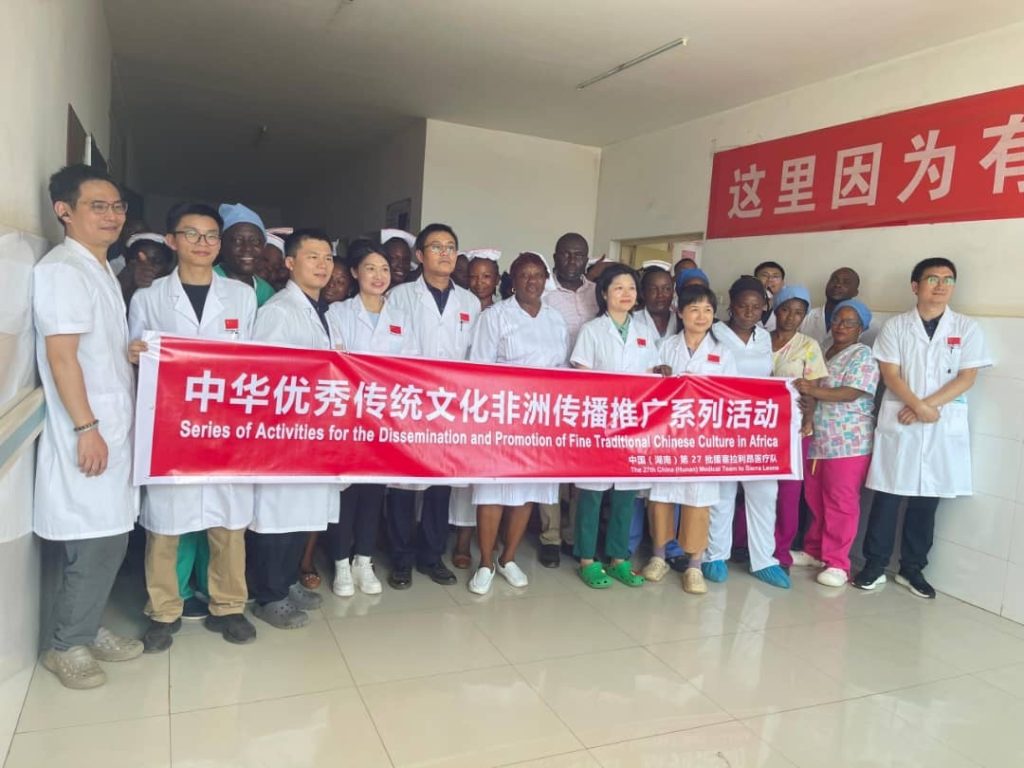
Yet on May 20, specialists from the 27th China (Hunan) Medical Team to Sierra Leone successfully carried out a high-difficulty extrafascial total hysterectomy — a sophisticated and internationally recognized surgical procedure rarely performed under such demanding circumstances in Sierra Leone.
The successful operation has since been hailed as another milestone in the growing medical cooperation between China and Sierra Leone, while also offering renewed hope to women suffering from complex gynecological conditions across the country.
A Decade of Silent Suffering
For ten years, the patient reportedly lived with progressive abdominal distension, a condition that gradually affected her quality of life. Like many women in developing countries, access to specialized diagnostic services and advanced gynecological interventions remained limited, allowing the fibroids to grow unchecked.
By the time she arrived at the China-Sierra Leone Friendship Hospital, the condition had become critical.
CT scans revealed multiple giant fibroids that had dramatically enlarged the uterus. The abnormal growth occupied much of the pelvic cavity, leaving little surgical space and significantly increasing the risk of complications involving nearby organs such as the bladder, intestines, and rectum.
For most surgical teams, such a case would demand meticulous preparation, advanced technical expertise, and exceptional coordination.
A Highly Specialized Procedure
The operation was led by a gynecological expert from the 27th China (Hunan) Medical Team, whose members have been working alongside Sierra Leonean healthcare professionals to strengthen local medical capacity and improve specialized healthcare delivery.
Instead of using a conventional hysterectomy approach, the team opted for an extrafascial total hysterectomy an advanced surgical technique performed outside the uterine fascial plane.
The procedure is considered highly demanding because it requires surgeons to navigate delicate anatomical structures with extreme precision while ensuring complete removal of diseased tissue.
Medical experts note that the technique offers several major advantages over traditional surgical methods:
More Complete Removal of Diseased Tissue
By operating outside the uterine fascia, surgeons are able to achieve a more comprehensive resection of fibroids and affected tissue. This significantly lowers the likelihood of residual lesions and future recurrence.
Reduced Long-Term Oncological Risks
Extrafascial surgery also creates safer surgical margins, reducing the possibility of pathological progression and providing additional protection where hidden or potential lesions may exist.
Lower Risk of Surgical Complications
One of the greatest dangers during complex hysterectomy procedures is accidental injury to surrounding organs. Because the anatomical layers are carefully separated during extrafascial surgery, the risk of damage to the bladder, ureters, and rectum is substantially reduced.
The result is often faster recovery, less postoperative trauma, and improved long-term outcomes for patients.
A Successful Outcome
Despite the enormous complexity of the case, the surgery was completed successfully.
Hospital sources confirmed that the patient recovered well after the operation and has already resumed normal daily activities an outcome that only weeks earlier might have seemed uncertain.
For the medical team, the success represented more than a single surgical achievement. It demonstrated the growing ability of international medical partnerships to bring advanced specialist care to Sierra Leone while simultaneously strengthening local clinical standards.
Strengthening China–Sierra Leone Medical Cooperation
The 27th China (Hunan) Medical Team forms part of a long-standing health cooperation program between China and Sierra Leone, through which Chinese medical professionals provide clinical services, surgical support, training, and technical assistance to Sierra Leonean healthcare institutions.
Over the years, Chinese medical teams have contributed to surgeries, infectious disease control, maternal healthcare, and emergency response efforts in Sierra Leone. However, highly specialized procedures such as this recent extrafascial hysterectomy signal an important evolution in the partnership — from basic service delivery toward advanced tertiary care and knowledge transfer.
Healthcare observers say such developments are critical for Sierra Leone, where many patients with complicated gynecological conditions are often forced to seek expensive treatment abroad or endure prolonged suffering due to limited local specialist options.
By introducing advanced surgical techniques and mentoring local practitioners, international collaborations can help reduce those gaps and gradually build sustainable specialist healthcare capacity within the country.
A New Benchmark for Women’s Healthcare
Uterine fibroids remain one of the most common gynecological conditions affecting women worldwide, particularly women of African descent. In many cases, delayed diagnosis and limited access to specialist care can lead to severe complications including chronic pain, excessive bleeding, infertility, and life-threatening anemia.
The successful completion of this operation therefore carries significance beyond a single hospital theatre.
It highlights the growing potential for Sierra Leone’s healthcare system to handle increasingly complex medical cases domestically. It also underscores the importance of investment in specialist training, medical infrastructure, and international collaboration in improving women’s health outcomes.
For one patient, the surgery meant relief after years of discomfort and uncertainty.
For Sierra Leone’s medical community, it marked another step toward a future where advanced healthcare is becoming more accessible, more sophisticated, and increasingly life-changing.

