
By Marius Musa Kargbo
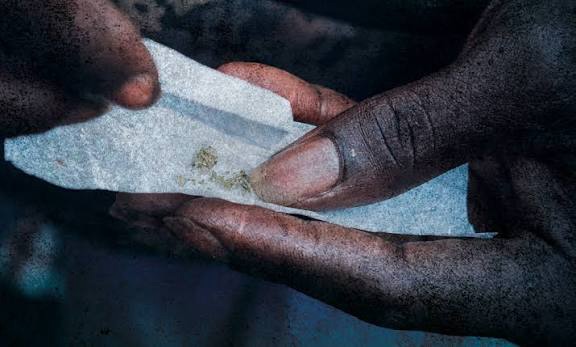
Along the crowded streets of Freetown, the signs are difficult to ignore. Young men sit slumped on roadside corners, some barely conscious, others wandering in visible distress after consuming Kush, the dangerous synthetic drug that has rapidly spread across Sierra Leone’s urban communities.
What began as a public health concern has now evolved into a broader national debate involving poverty, governance, youth unemployment and state responsibility. Increasingly, activists, researchers and ordinary citizens are asking whether the Kush epidemic reflects not only social collapse, but also political failure.
While there is no verified evidence that Kush was intentionally introduced or promoted by political actors to control young people, analysts and civil society commentators argue that the worsening crisis has exposed how vulnerable Sierra Leone’s unemployed youth population has become.
A Crisis Rooted in Despair
Researchers and public health experts have linked the rise of Kush to widespread economic hardship, unemployment, trauma and social exclusion among young people.
A study published on MedRxiv examining Kush consumption in Sierra Leone found that many users reported turning to the drug as a coping mechanism for poverty, stress and hopelessness. The researchers argued that structural socioeconomic conditions have played a major role in driving addiction among vulnerable youths.
Freelance reporter Mohamed Amara has reported extensively on the growing Kush epidemic, describing how the drug has spread rapidly among unemployed youths in urban communities where economic opportunities remain limited. According to his reporting, many young users view Kush as an escape from hardship and uncertainty.
A recovering addict interviewed by Deutsche Welle described his situation bluntly, saying he was “addicted to a bad system,” a statement many observers interpreted as frustration with broader economic and governance challenges rather than simply personal weakness.
Public policy analysts say such testimonies reveal a dangerous intersection between economic hardship and substance abuse.
The Political Debate
The question of whether the Kush crisis has political implications remains deeply sensitive.
Some civil society advocates and social commentators argue that prolonged government inaction allowed the problem to escalate unchecked. According to these critics, a frustrated youth population struggling with addiction is less likely to organize politically or demand accountability.
However, these claims remain opinions expressed by commentators and citizens rather than established fact.
Political analyst Ibrahim Sorie, speaking during a local radio discussion in Freetown earlier this year, argued that “when unemployment and hopelessness persist for too long, drugs become both an escape and a symptom of governance failure.” His comments reflected a broader concern shared by many youth advocates.
Social media discussions have also amplified public suspicion. Several Sierra Leonean commentators online have questioned why authorities appeared slow to respond decisively during the early stages of the epidemic. Others, however, reject suggestions of political conspiracy and instead blame weak institutions, porous borders and organized criminal networks.
Security experts interviewed by ENACT Africa have pointed to cross-border trafficking and weak law enforcement capacity as major factors behind the spread of Kush across the Mano River region.
Government Response
The Sierra Leonean government has publicly acknowledged the seriousness of the crisis.
In 2024, President Julius Maada Bio declared Kush abuse a national emergency and announced a coordinated response involving law enforcement agencies, health authorities and community organizations.
Government officials have consistently denied allegations of political indifference. Authorities maintain that the administration is treating the epidemic as a major national security and public health issue.
The National Drug Law Enforcement Agency has intensified raids and arrests linked to narcotics distribution, while the Ministry of Health has promoted rehabilitation and awareness programs.
Speaking during a government briefing earlier this year, officials warned that Kush poses a serious threat to national productivity, public safety and youth development.
Nonetheless, critics argue that enforcement alone will not resolve the underlying causes of addiction.
Beyond Criminalization
Mental health professionals and development experts say the Kush epidemic cannot be separated from Sierra Leone’s broader socioeconomic challenges.
Youth unemployment remains a major concern across the country. Many graduates and school leavers struggle to find stable employment, while rising living costs continue to place pressure on families.
According to researchers and social workers, such conditions create fertile ground for substance abuse.
Public health advocates have also raised concerns about Sierra Leone’s limited rehabilitation infrastructure. Families dealing with addicted relatives often face enormous financial and emotional strain, particularly in communities where treatment facilities are scarce.
International media reports and local health workers have documented cases of desperate families restraining addicted relatives because of the absence of accessible rehabilitation services.
Experts caution that reducing the crisis to a purely criminal matter risks ignoring the deeper social realities driving addiction.
As sociologist Mohamed Bangura explained during a university public forum in Freetown, “drug abuse among youths is often connected to unemployment, trauma and social hopelessness. Without addressing those root causes, the problem will continue.”
A Generation at Risk
What remains undeniable is the scale of the crisis facing Sierra Leone’s youth population.
Community leaders, teachers, religious figures and healthcare workers all warn that Kush addiction is destroying lives, increasing crime and weakening already fragile communities.
For many observers, the debate is no longer simply about drugs. It is about whether Sierra Leone can provide enough opportunity, dignity and hope for its growing youth population.
Analysts say the country’s long-term stability may depend on how effectively it addresses unemployment, mental health, education and social protection alongside law enforcement.
While accusations that Kush is being used deliberately as a political tool remain unproven, the perception itself reflects deep public frustration and mistrust.
Ultimately, the Kush epidemic has become a mirror reflecting Sierra Leone’s broader struggles poverty, inequality, weak institutions and the growing despair of young people searching for survival in difficult circumstances.
For many families across the country, the fear is no longer abstract.
It is personal, immediate and unfolding every day on the streets.

