
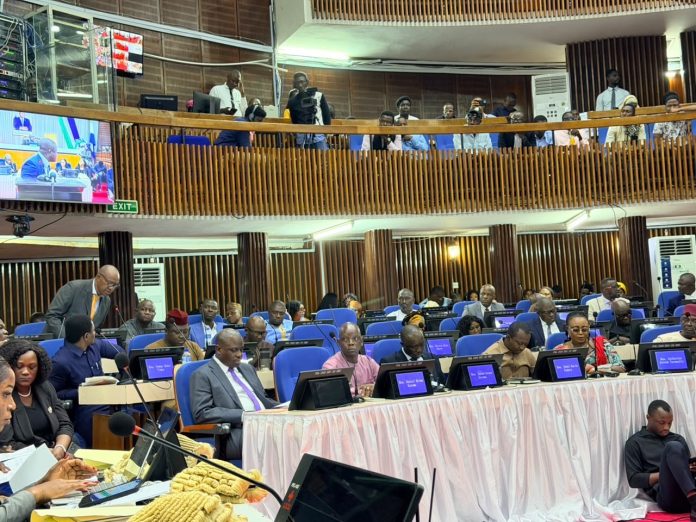
Marius Musa Kargbo, AYV News, August 11, 2026
Sierra Leone’s Parliament has passed the Constitutional Amendment Bill, 2025, following a dramatic and highly contested sitting that saw the Opposition All People’s Congress (APC) Parliamentary Caucus walk out of the Chamber over a dispute concerning the voting threshold required for constitutional amendments.
The controversy centres on the interpretation of the constitutional provisions governing the passage of Bills seeking to amend the Constitution.
Section 108(2)(b) of the 1991 Constitution provides that a Bill seeking to alter the Constitution shall not be passed by Parliament unless, at its second and third readings, it is supported by the votes of not less than two-thirds of the Members of Parliament.
On the other hand, Section 91(1) establishes the general rule that, except where the Constitution provides otherwise, questions before Parliament are determined by a majority of the votes of Members present and voting.
It is the relationship between these two provisions that became central to the parliamentary dispute.
The APC Parliamentary Caucus maintained that Section 108(2)(b) requires a constitutional amendment to obtain the support of two-thirds of the Members of Parliament, arguing that the absence or withdrawal of Opposition MPs could not alter the constitutionally prescribed threshold.
The Speaker of Parliament, Rt. Hon. Segepoh Solomon Thomas, however, ruled on the applicable voting procedure, leading the APC Caucus to walk out of the Chamber in protest.
Despite the walkout, Parliament proceeded with consideration of the Bill and subsequently passed it.
In a significant development during the proceedings, the Speaker indicated that the constitutional question should be referred to the Supreme Court for clarification, particularly regarding the interpretation of the relevant constitutional provisions and the voting threshold applicable at the various stages of the amendment process.
The Supreme Court has constitutional jurisdiction to determine questions relating to the interpretation of the Constitution, making any judicial clarification potentially significant to the issues arising from the parliamentary proceedings.
The dispute has therefore moved beyond disagreement over the substance of the proposed amendments and into a broader constitutional debate over how Parliament should interpret and apply the provisions governing constitutional amendments.
The passage of the Bill follows weeks of intense political and public debate over the proposed reforms.
The Government has defended the amendments as necessary measures aimed at strengthening Sierra Leone’s democratic and governance institutions, while the Opposition has raised concerns over aspects of the proposed changes and the procedure through which the amendments were considered.
The APC’s walkout has added further political significance to the passage of the Bill, particularly given the Opposition’s insistence that the constitutional threshold for amendments must be strictly observed.
With Parliament having now passed the Bill, attention is expected to shift towards the constitutional implications of the proceedings and whether the Supreme Court will be called upon to provide authoritative clarification on the disputed provisions.
The outcome of any such constitutional interpretation could have implications not only for the current amendment process but also for how future constitutional amendments are considered and passed by Parliament.
Parliament has subsequently been adjourned until 29 October 2026.

