
By Marius Musa Kargbo
Sierra Leone’s senior citizens are facing persistent challenges ranging from inadequate social protection and healthcare to limited residential care, abuse and financial insecurity, with advocates calling for stronger government intervention to protect the rights and dignity of older people.
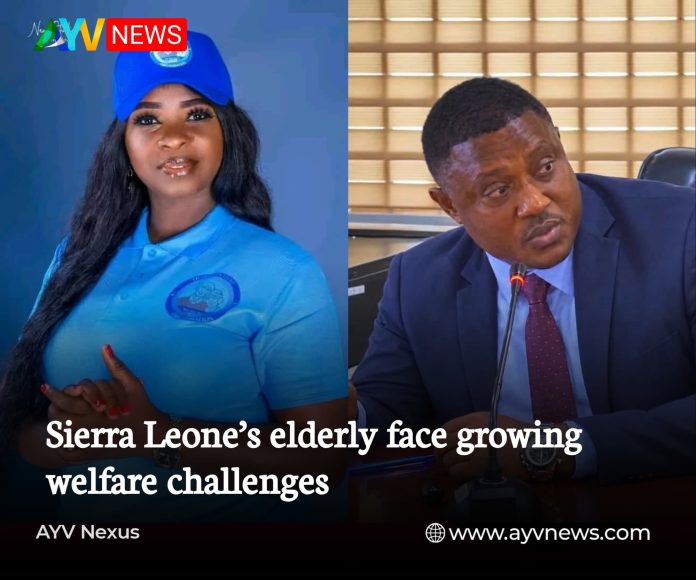
Speaking on AYV’s Wake Up Sierra Leone, Doreen Barrie, Founder and CEO of the Dorwontony Organisation for the Aged (DOFA), said the country needs stronger legal protection for senior citizens, arguing that an Act would create obligations across government institutions rather than leaving elderly issues to a policy that may not be adequately understood or implemented.
“We need to have an Act for senior citizens. An Act will take us to another level because it would make support for senior citizens a legal obligation, rather than relying on a policy that many ministries are not even aware of.”
Barrie said elderly people continue to depend heavily on charitable support for basic necessities, including food and medical care. She said DOFA conducts regular medical check-ups and feeding programmes, but limited resources make it difficult to reach the growing number of vulnerable elderly people across the country.
“We beg for medication, we beg for food, and we beg people to give us money to care for senior citizens. These people have done something for this country, yet we have to keep begging to care for them.”
Her concerns are reflected in Sierra Leone’s National Social Protection Strategy, which identifies older people as a vulnerable group and acknowledges gaps including irregular and insufficient government support to homes for the needy aged and the absence of a government-owned residential facility for vulnerable older people.
The government already has social protection mechanisms that include assistance for vulnerable people aged 60 and above who have no regular income or other means of support. The National Social Protection Authority, established under the Social Protection Act, is also mandated to coordinate social protection programmes and promote an age-appropriate social protection system.
However, John Conteh, Acting Director of Social and Religious Affairs at the Ministry of Social Welfare, acknowledged that the country does not yet have enough homes for older people. He said the Ministry is developing a policy for older persons that is expected to provide a framework for establishing additional homes for the aged.
“We recognise that we do not have enough homes for the aged. As a Ministry, however, we are developing a policy for older persons that will pave the way for the establishment of more homes for the aged.”
Conteh also said the Ministry has a budget line addressing the challenges faced by senior citizens, although he acknowledged that available resources are insufficient and that government continues to work with partners to complement its efforts.
“We have a budget line under the Ministry of Social Welfare that directly addresses these challenges. Although the funds are not sufficient, we are working closely with our partners to complement the government’s efforts.”
The government’s own social welfare planning documents similarly identify irregular and insufficient grants to homes for needy older people as a gap, while noting the absence of a government-owned board-and-lodging facility for vulnerable elderly people.
Barrie is calling for a more comprehensive approach, including the creation of an elders’ village where retired and vulnerable senior citizens could access accommodation, food and medical care in a structured environment.
“What we need is the government’s commitment to ensuring that what is being proposed is implemented. We can establish an elders’ village where retired people can live and have access to accommodation, medical care and food, making life easier for senior citizens.”
The issue extends beyond poverty and healthcare. Barrie said DOFA has also received reports of abuse against elderly people, while Conteh said government institutions and partners must strengthen interventions to protect older persons from discrimination and abuse.
Sierra Leone’s Medium-Term National Development Plan recognises the contribution of older people to national development, including continued economic activity, while the National Social Protection Strategy identifies income security, health, housing, welfare and nutrition as key areas requiring attention.
As the global population ages, the United Nations has urged countries to strengthen social protection and prioritise the rights and wellbeing of older people.
For Sierra Leone, the challenge is therefore not simply about caring for people after retirement. It is about building a system that allows citizens to age with dignity, security and access to essential services and ensuring that those who spent their productive years contributing to society are not left vulnerable in the final stage of their lives.

